



Scale Integrations Without Scaling Your Integrations Team
If you’re building technology for restaurants, integrations are almost always part of the equation.
POS companies, first-party ordering platforms, AI ordering providers, kiosk companies, delivery platforms and other restaurant technology companies all run into the same challenge: customers want your product to work with the systems they already use.
You can build those integrations directly, and in some cases that may be the right path. But the part that often gets underestimated is everything that comes after the initial build.
The Build Is Only Part of the Work
An integration is not something you build once and never touch again.
APIs change. Authentication requirements evolve. New functionality is introduced. Menu structures and order flows change. Customers need adjustments as they go live.
“The initial build is scoped and finite. The work that comes after it isn’t. Customers need changes, partners move toward go-live, and platforms update requirements. Those needs are real, ongoing, and they don’t always line up with your product roadmap.”
Evan Whitten, CTO, Stream
That ongoing work has to live somewhere. If your team owns the integration directly, it remains an engineering responsibility for as long as you support it.
That is where Stream comes in.
One Build Into Stream
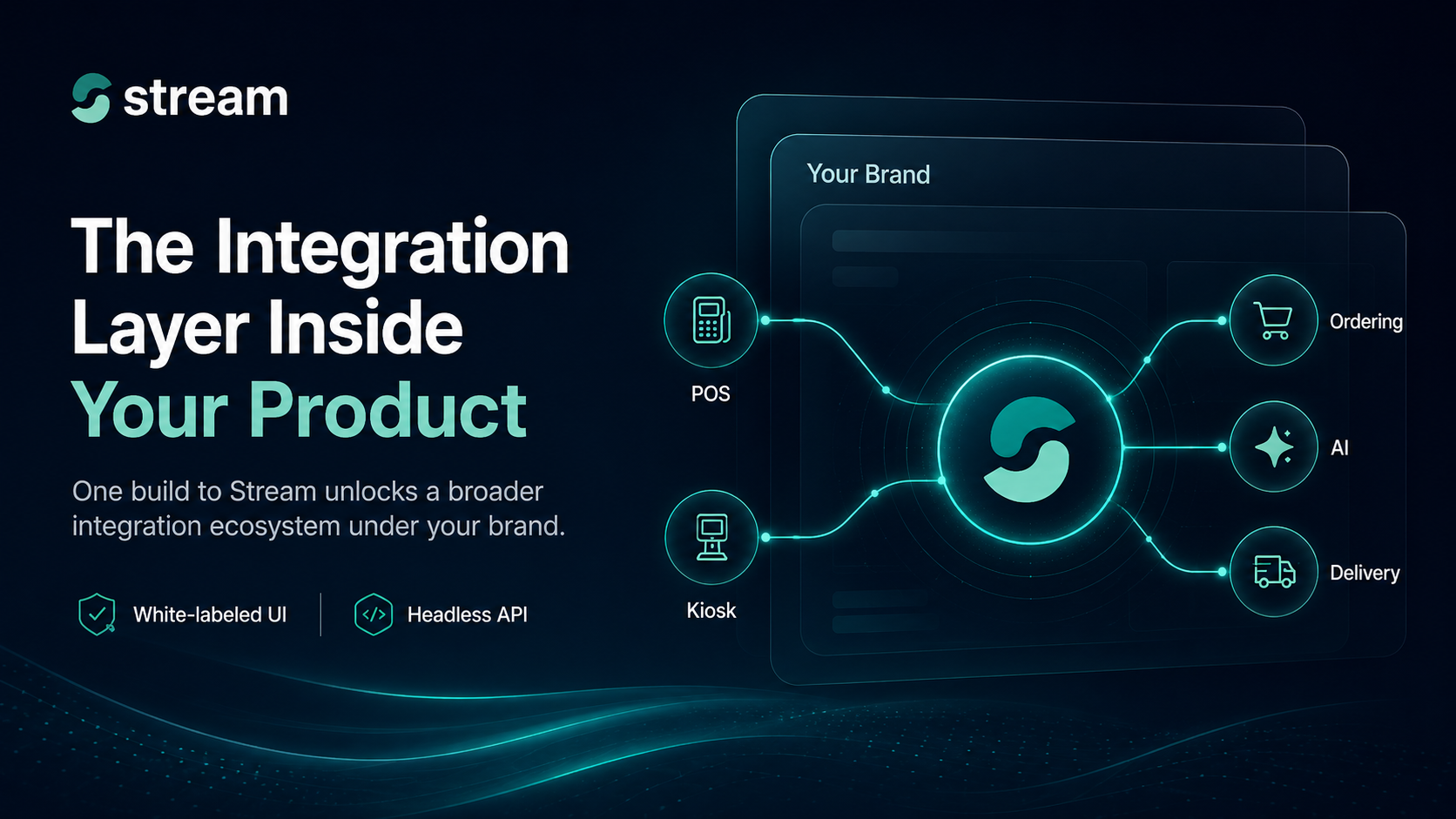
With one build to Stream’s APIs, you can access Stream’s broader integration ecosystem without having to build and maintain each connection individually.
Stream handles the ongoing work behind those integrations, including API updates, authentication changes, certifications and new requirements.
As Evan Whitten puts it, “Handling that ongoing work at the integration layer is Stream’s job, so our partners can stay focused on the differentiated product only they can build.”
That’s the value: Stream owns the integration layer, while our partners stay focused on their core product and customers.
Stream Can Live Inside Your Product
.png)
For companies that want integrations to feel like a native part of their own technology, Stream can be fully white-labeled.
We support two approaches:
White-labeled UI: Stream’s interface can live within your platform using your branding, colors and customer experience. For companies that do not want to build all of the UI needed to manage multiple third-party integrations, this provides a much faster path to market.
Headless: For companies that already have the UI they want, Stream can operate completely behind the scenes, with data flowing through our APIs and webhooks.
Either way, you control the branding, customer experience, pricing and customer relationship.
Your customers stay inside your ecosystem while Stream handles the integration infrastructure behind the scenes.
That is an important distinction. Stream does not have to be another vendor sitting outside of your product. We can become the integration layer inside your technology stack and product offering.
Built for Restaurant Technology
For an AI ordering provider, that may mean focusing engineering resources on the AI experience instead of maintaining a growing list of POS connections.
For an ordering or kiosk platform, it can mean supporting more restaurant systems without having to build every connection internally.
For a POS provider, Stream can expand the number of ordering, delivery and restaurant technology platforms available to your customers without requiring your team to individually build and maintain every integration.
Today, Stream supports integrations across major platforms including Uber, DoorDash, Grubhub, ezCater, Fantuan, Slice, HungryPanda and many others, with additional capabilities across areas such as loyalty and payments continuing to expand.
.png)
Stream vs. Building Direct
There will always be situations where a direct integration makes sense.
The important thing is to look beyond the initial build.
Before committing to a direct integration, it is worth asking:
- Who maintains it next year?
- Who handles future API changes?
- What engineering and product resources will it require over time?
- What happens as customers ask for more integrations?
Stream provides another path.
One build into Stream gives you access to a broader ecosystem while our team handles the ongoing integration work.
And because Stream can operate behind your branding and inside your own product experience, your customers can still experience those integrations as a native part of your platform.
Focus on Your Core Product
The goal is simple: integrations should help your product grow without becoming a growing engineering burden of their own.
Stream gives restaurant technology companies a faster and more scalable way to expand connectivity while maintaining control of their brand, product experience and customer relationship.
--
Before you commit engineering resources to another direct build, talk to Stream. One build can give your product access to a broader integration ecosystem, while we handle the ongoing maintenance behind the scenes.
Your product. Your brand. Your customers. Stream handles the integrations.