



.png)
Stream Spotlight: Ambassador on Direct Ordering, Restaurant Data, and Building a More Connected Tech Stack
Restaurants are managing more digital channels than ever: online ordering, delivery, loyalty, marketing, guest feedback, POS data, and operational reporting.
For independent operators, the challenge is not simply adding more tools. It is making sure those tools work together in a way that improves profitability, strengthens guest relationships, and gives restaurants better visibility into their business.
Stream sat down with Nav Sangha, Founder of Ambassador, to talk about his background as a restaurant operator, the lessons he took from building Turnstyle Solutions, how Ambassador has evolved, why integrations matter, and where the company is headed next.
You’ve spent a lot of time building in and around the restaurant technology space, including Turnstyle Solutions, which was acquired by Yelp. How did that experience shape the way you think about restaurants, customer data, loyalty, and the opportunity you saw with Ambassador?
I actually got into tech from the brick-and-mortar operations side.
Before any of this, I owned and operated several restaurants and music venues, including Otto’s Bierhalle, Miss Thing’s, and The Great Hall in Toronto. My first experience with “customer data” was standing at the door on a Friday night with no idea who any of these people were, whether they had been in before, or how I was going to keep them coming back.
Turnstyle came out of that.
Leveraging smartphones and guest WiFi meant we could capture online-to-offline attribution. It was a game changer. Suddenly, we were able to help business owners understand who their regulars were and give them marketing tools to keep those guests coming back.
The Yelp acquisition taught me the other side of the market. Marketplaces create real opportunities for brick-and-mortar businesses by aggregating demand and helping consumers discover new restaurants. But they also highlighted a broader challenge: restaurants need a stronger way to build and maintain direct relationships with their own guests.
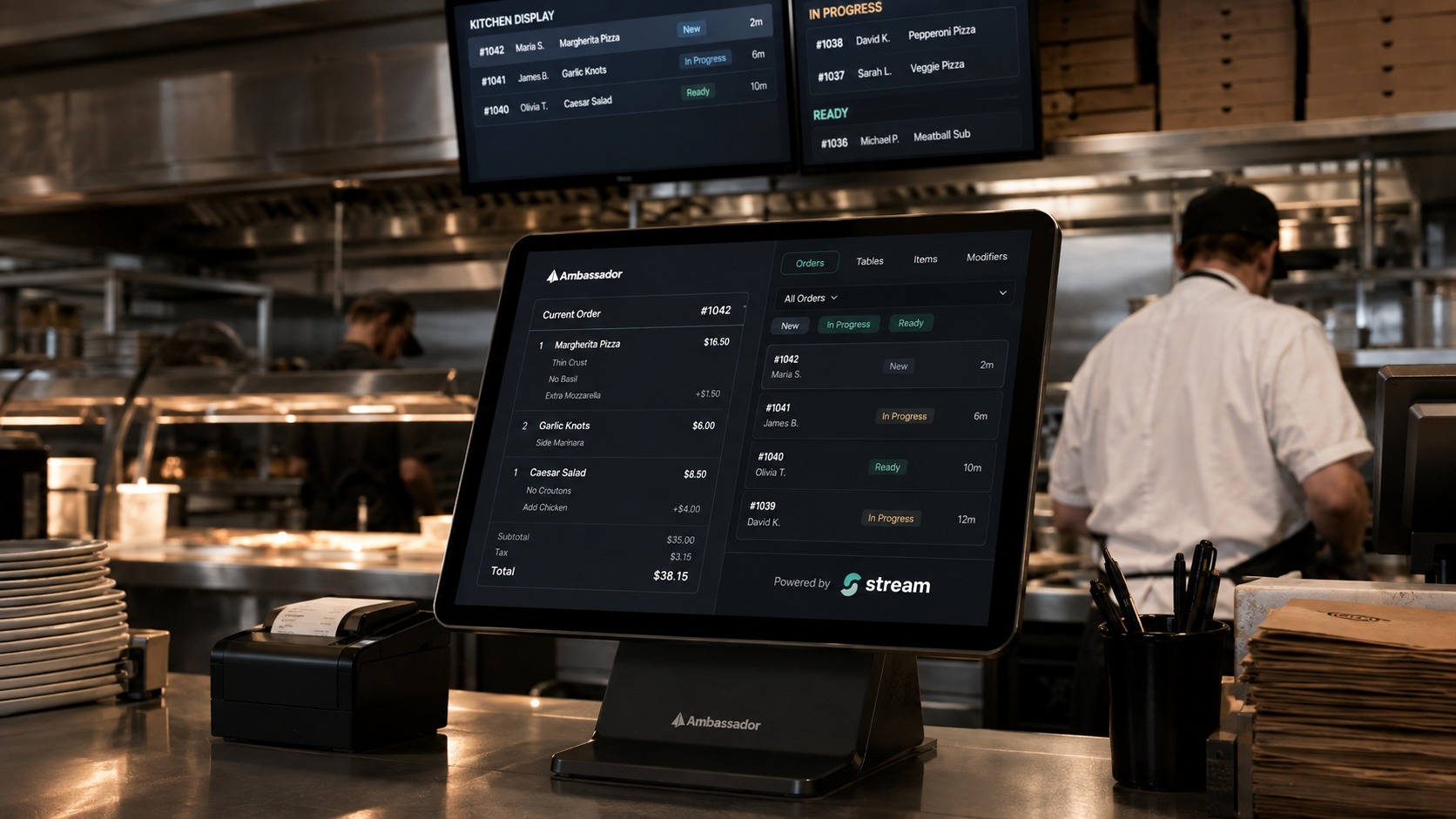
As delivery apps scaled, that same dynamic started to apply to transactions as well as discovery. For restaurants already operating on thin margins, it became clear that a sustainable digital strategy needed to include direct access to ordering, guest data, and marketing tools.
Ambassador was born out of that realization. Independent restaurants needed low-cost, direct access to the kind of digital tools and technology stack that larger enterprise brands already had.
Ambassador describes itself as a complete restaurant toolkit across online ordering, delivery, websites, guest feedback, growth marketing, and more. What problem were you originally trying to solve for restaurants, and how has the platform evolved since then?
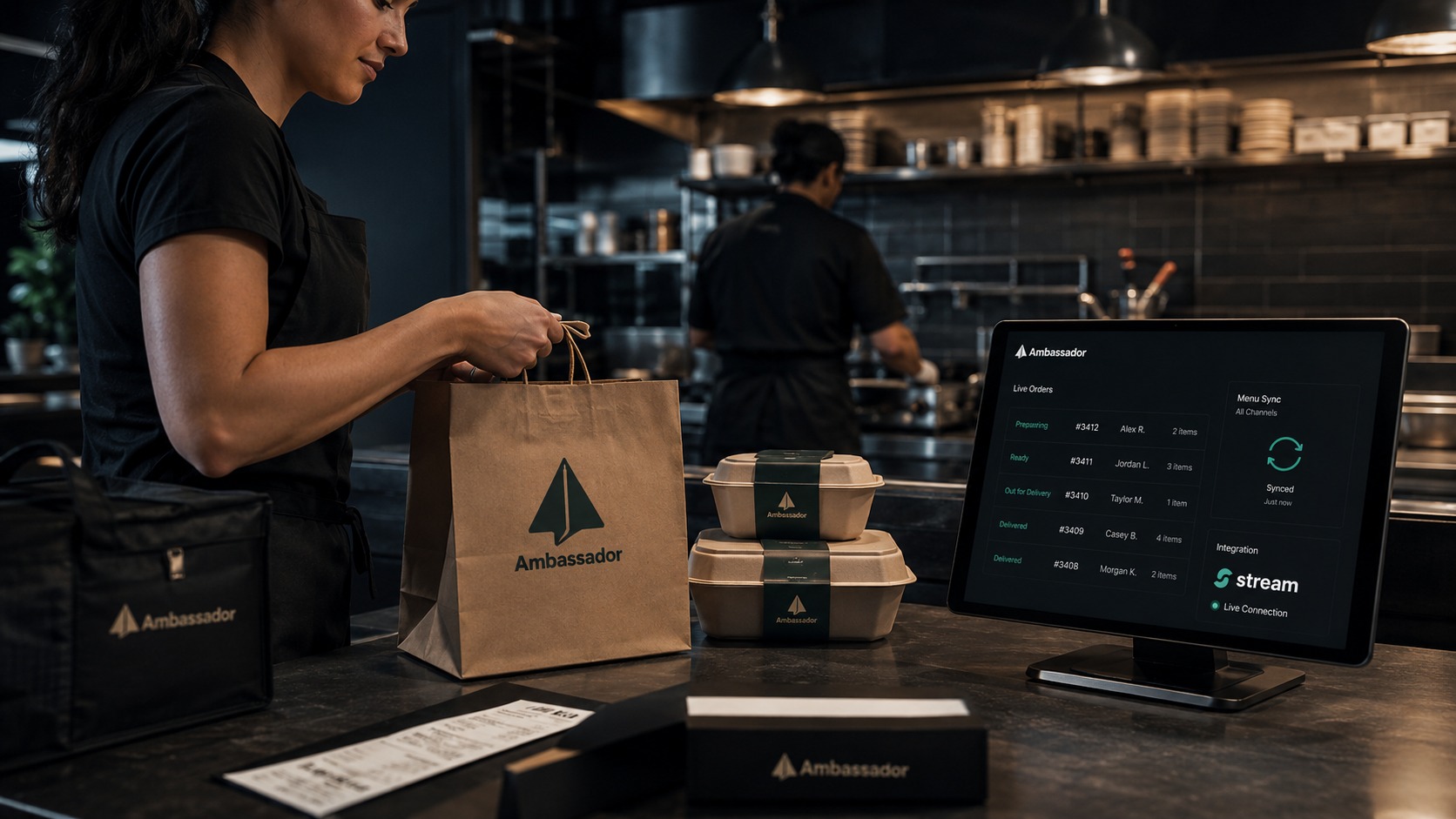
Restaurants needed a direct ordering experience that was simple, reliable, and compelling for guests.
We started with direct online ordering and commission-free delivery. Instead of taking a percentage of every order, we dispatch to courier networks at a flat cost. The goal was to help restaurants create a digital ordering experience that worked for the guest while improving the economics for the operator.
Everything since then has been built because we kept running into the same wall: you cannot own the guest relationship with an ordering page alone.
You need the website, loyalty, marketing, feedback, and reporting that tells you whether any of it is working. Our POS came later, partly because it is a natural entry point for independent restaurants, and partly because there is only so much you can do without the transaction record.
It was actually our users who pushed us to expand into developing our own POS layer. I still remember our team on day one in the Ambassador office saying we would never, ever build a POS system.
Online ordering is still our core product, whether it is web-based or through the native apps we help restaurants create. But the piece we care most about now is the analytics layer sitting on top, which we have built to work regardless of what POS the restaurant is using.
A lot of restaurant operators are trying to grow direct orders, reduce unnecessary costs, and build stronger relationships with their customers. Where do you think Ambassador creates the biggest advantage for restaurants as they manage more digital channels and customer touchpoints?
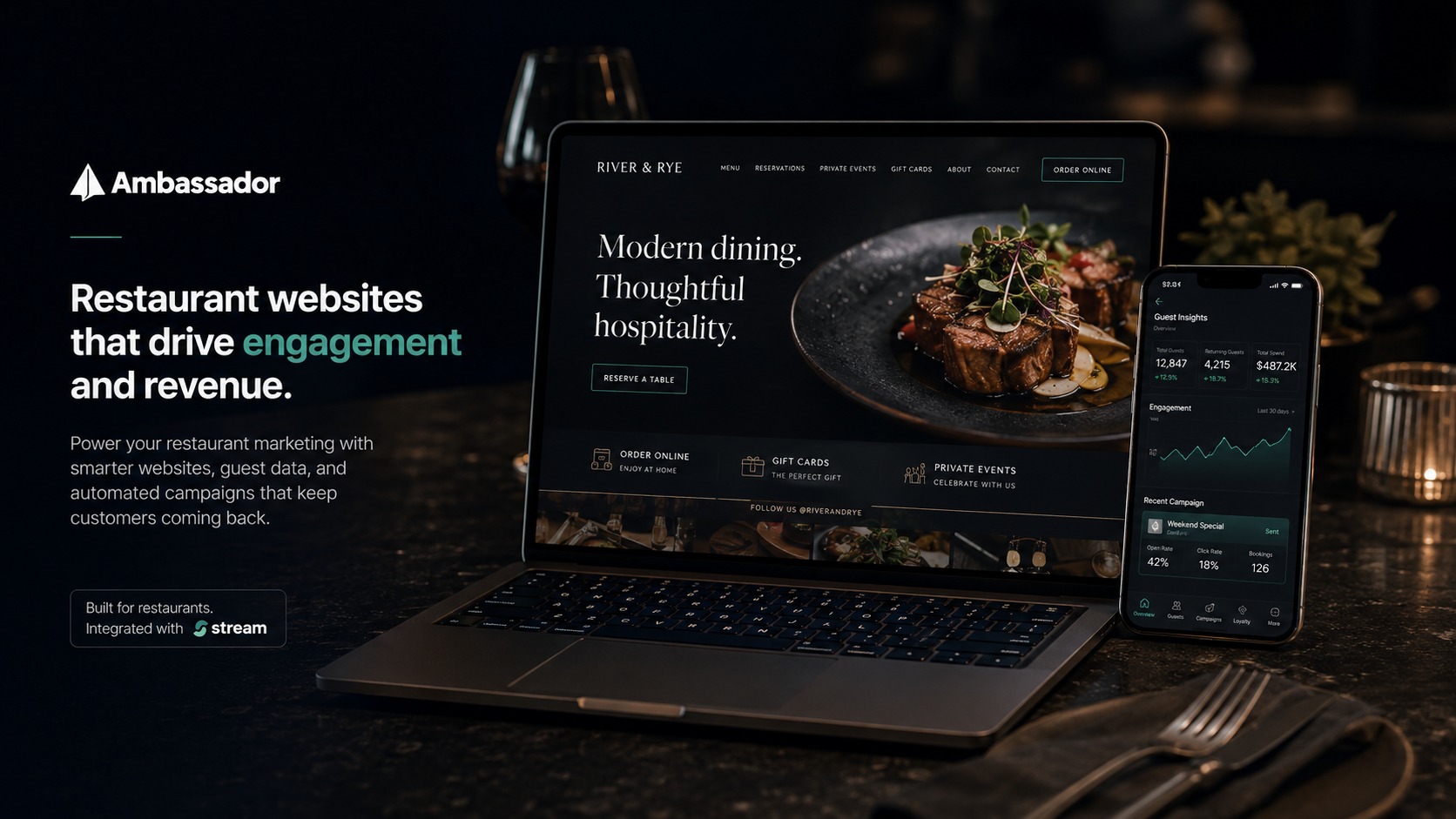
The obvious one is margin.
Marketplaces can be an important part of a restaurant’s digital strategy, and direct ordering gives operators another channel where they have more control over the guest relationship and economics.
The second is that the customer relationship becomes stronger.
When a restaurant has access to the guest record, loyalty becomes more than a discount. It becomes a retention program that can be measured, refined, and improved over time.
The third is the one operators sometimes underrate until they see it: the data lands in one place.
When ordering, POS, delivery, and loyalty data do not connect cleanly, it becomes difficult to answer basic questions. Did that promotion actually lift sales, or did it just discount orders that would have happened anyway? Which hours are worth staffing? Which guests are coming back?
We answer those questions for clients constantly, and it only works because their channels are no longer operating in silos.
As restaurants add more digital channels, the technology stack can get complicated quickly. How does Ambassador think about integrations, and why is it important that ordering, POS, delivery, marketing, and customer data can work together cleanly?
While we now have our own POS system, we are still built to be POS agnostic and additive.
Most operators do not want to rip out a system that already works. I remember how hard it was to switch a POS system from my own days as an operator. If something is working fairly well for a restaurant, our approach is to make it better by layering our marketing, ordering, and analytics tools over it.
The hard part of an integration is never just the API. It is the menu, and the quality of the data that comes back across.
Menus are messier than people assume. A pizza is not just one item. It is a size, a crust, a base, and modifiers that might only apply to half the pie, with pricing that depends on the combination. Getting that to map cleanly between two systems is genuinely hard work.
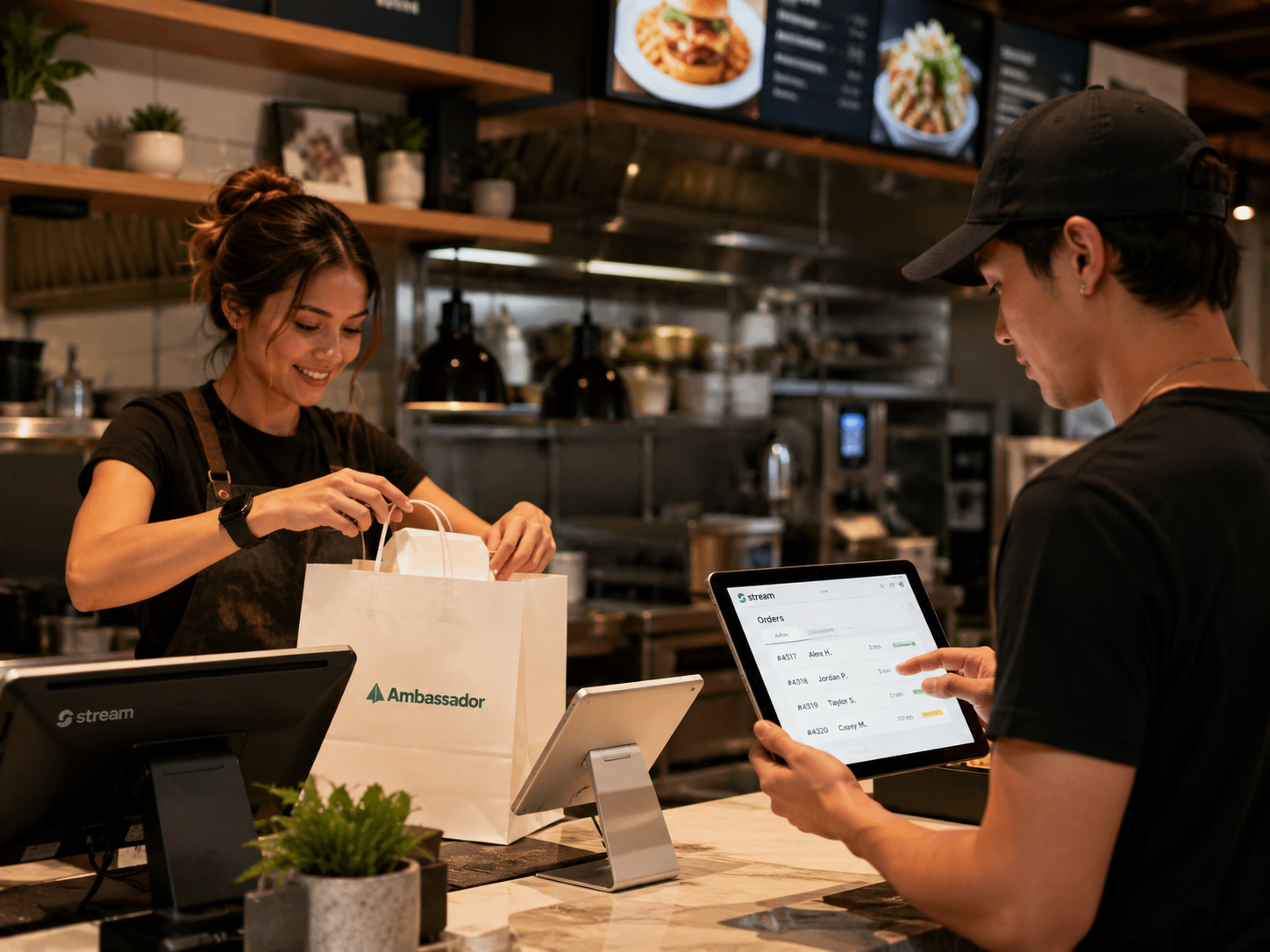
When it is wrong, you do not get a tidy error message. You get a wrong pie, a remake, and a kitchen that has stopped trusting the tablet by Friday night. I have watched staff give up on a system for exactly that reason.
The other thing I care about is what the data actually looks like once it lands.
Plenty of integrations pass over an order total and consider the job done. That is fine for a receipt, but it is not enough for what happens after the order. You cannot measure a promotion, an item’s real margin, or an hour’s worth of labor off a total alone.
If we are not getting item-level detail, we are moving the transaction without learning enough from it.
Ambassador and Stream work together to help restaurants connect ordering and delivery activity back into the systems they already use. Where has Stream helped strengthen the Ambassador offering, and what does that unlock for restaurants using the platform?
Stream solves our scaling problem.
We can build end-to-end connections to every system a client runs, and they will work. But then we own that maintenance forever, and the next client with a different stack starts the process over again. That is engineering time going into plumbing instead of our core product.
Menu mapping is the piece we pay closest attention to. Multi-variant items, with pizza being one of the hardest examples, are where many integrations quietly fail. That is the first thing we pressure test with any connection.
Getting sizes, configurations, and modifiers to come across properly is the difference between an integration that works on paper and one that works on a Friday night.
Stream’s support and onboarding have also been genuinely strong, which matters more than people expect. A lot of integration partners hand you documentation and disappear. Being able to get a real answer quickly when something does not behave the way we expected is a big part of why this integration works for us, and more importantly, for our merchants.
Stream is also a big part of how we stay POS agnostic.
We can keep working with systems like Toast, Square, and Clover, and make them better without disrupting what is already familiar to the restaurant owner. For the operator, that means they can keep the system their staff already knows while still getting a direct ordering channel that feeds it cleanly.
Orders land where they should, the back office ties out, and nobody is retyping tickets.
Can you share a merchant example where Ambassador, together with strong integrations, created a meaningful impact for the restaurant?
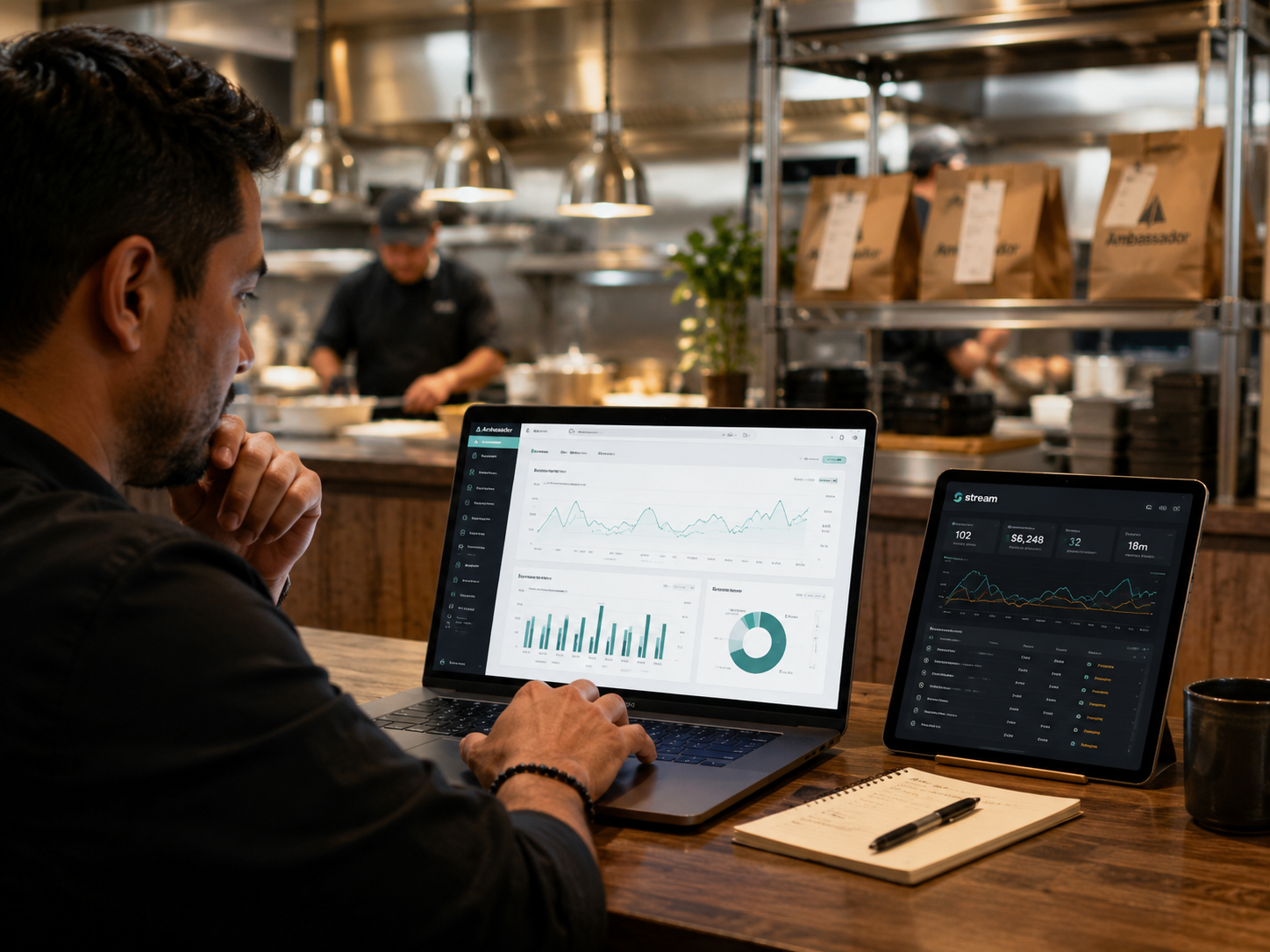
Blondies Pizza is a great example.
They are a multi-location brand and have been with us through basically every phase of the platform, so they are one of the best examples of what happens when all of this comes together.
The first thing that changed was channel mix. We helped Blondies grow direct ordering as a more meaningful part of their overall digital channel mix. On orders placed through that channel, they save an average of 25% in commission.
Same guest, same pizza, but more of the order value stays in the business. That gap repeats every week across each location, which is what makes it matter.
The second thing that changed was measurement.
Their loyalty program runs on first-party data, so when they run a promotion, we can go back afterward and understand how much of the lift was genuinely new volume versus orders they would have received anyway. Most restaurants run promotions on instinct and never really find out.
The third piece is the one operators do not always expect.
Because the data arrives cleanly, it can be used for real decisions. Staffing can be built around actual demand by hour instead of what happened last year. When they are looking at a new neighborhood, they can see where delivery orders are already coming from and make decisions based on evidence rather than a hunch.
None of that last part is possible without the first part being done properly. That is really the argument for strong integrations.
Looking ahead, where is Ambassador headed? What are you most excited about as restaurants become more data-driven, more connected, and more focused on owning the guest relationship?
We are most excited about the data and AI layer.
AI has made a lot of ideas we once talked about feel much closer to reality. The difference in how we are approaching it is that we are keeping ours POS agnostic.
Ordering remains core to our engine today, and restaurants now have more technology options than ever. What is still underdeveloped is taking a restaurant’s whole operating picture, including sales, top sellers, labor, guests, delivery, and costs, and turning it into a decision they can act on this week.
Many platforms are starting to move in this direction, but the intelligence layer is often tied to a specific POS or closed ecosystem. Our view is that restaurants should be able to benefit from better data and automation across the systems they already use.
The intelligence layer should sit above the stack and get better with every system it connects to. That is exactly why a partnership like Stream matters to us beyond the commercial side of it.
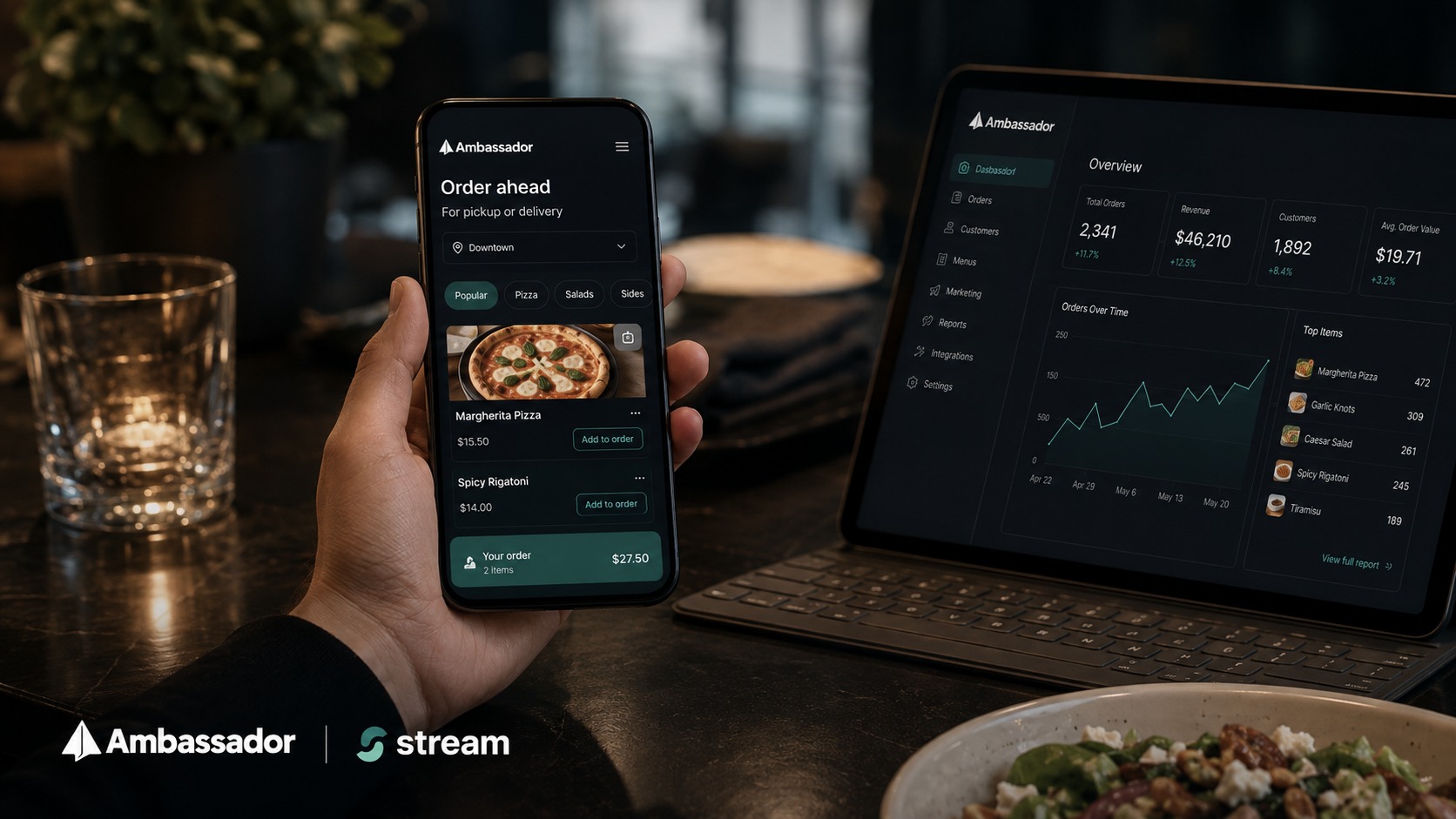
The specific thing I want is to replace reports with answers.
An operator should be able to ask why last Tuesday was soft and get a real response from their own data in the moment, instead of waiting on my team to go build something.
We are working toward the same thing on the labor side, since payroll is the second biggest line on the P&L and it almost never sits next to sales in the same system.
None of this is that different from the ideas I had when I was starting out at Turnstyle. It is the same vision, but with better data and better automation behind it.
Besides the bottom line, the guest relationship and the customer data behind it are still some of the most important things a restaurant owns. Our job is to make sure the operator is the one who can use them.
--
For Ambassador, the future is not just more reports. It is better answers.
By combining direct ordering, guest data, restaurant analytics, and strong integrations, Ambassador is helping operators better understand their business and act on what they learn. Stream is proud to support that vision by powering the connectivity layer behind the scenes.
For restaurant technology companies looking to expand their integration capabilities, support more POS systems, or offer white-label connectivity under their own brand, reach out to Stream to discuss how we can help.