


Inside heytruffle’s Managed Approach to Voice AI Ordering and POS Connectivity
“Everything we build has to fit the systems the operator already runs. We are in hospitality to grow their top line, not to hand them one more thing to manage.”
That is why the POS integration came before everything else.
Voice is becoming a real ordering channel for restaurants, and it is hitting the same wall every other channel hit first. Holding a conversation is the easy part. Getting an order into the POS correctly, with the right modifiers, at the right price, for the right location, is not.
heytruffle runs a fully managed AI Concierge for multi-unit restaurant groups, answering calls for reservations, pickup orders, delivery, catering and large party inquiries. We spoke with founder and CEO Lucas Espina about where the company came from, why it operates as a service rather than simply shipping software, and why it chose to build its POS connectivity on Stream.
What inspired the creation of heytruffle?
We did not start as a technology company. We started inside restaurant operations, and heytruffle came out of a problem we had ourselves. The phone kept ringing and nobody could get to it, and the part that bothered me was that there was no record of it. A missed delivery shows up somewhere. A missed call does not. The revenue simply never arrives and nobody can tell you how much of it there was.
So we audited the phone lines. The calls we were missing were not noise, they were orders, large parties and catering inquiries. Direct revenue, from demand we had already paid to create, and nobody in the building could see it going.
Once you see it you cannot staff your way out of it. A person can only hold one conversation at a time, and the calls worth the most arrive at exactly the moment nobody is free.
We built an AI Concierge to pick up every one of those calls, trained on each restaurant’s menu, policies and way of speaking, with our team behind it. That order of events still shapes the company. We are not trying to automate hospitality. We are trying to capture the demand the restaurant already paid to create.
What actually breaks when voice AI meets a real restaurant menu?
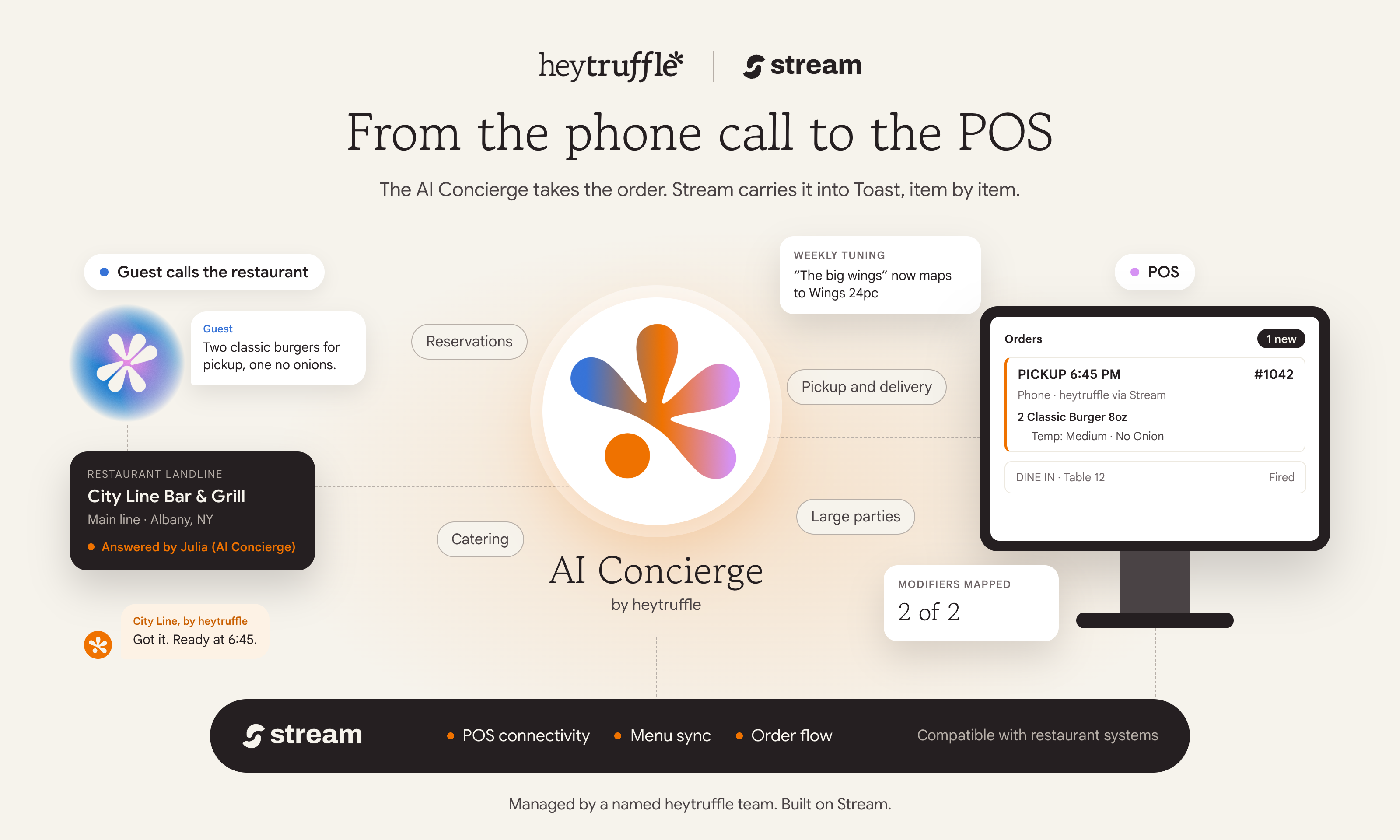
Demos run on clean menus. Real menus are not clean. A single item can carry a dozen modifier groups, some required and some not, with rules that only make sense to the people who work there. Prices differ by location and by channel. Items sell out in the middle of a shift.
So the hard part is not understanding speech. The hard part is mapping what a guest actually says, in the order they say it, with the corrections they make halfway through, onto a catalog built for a terminal.
We treat that as three jobs. Hold the conversation naturally, including interruptions. Resolve what was said into real items and real modifier selections for that specific location. And know when it is not confident, and hand the call to a person rather than guess.
That last one matters most, and it is also why we run this as a service instead of shipping software. Every restaurant gets an AI Concierge trained on its own brand, menu and policies, and our team reviews calls and tunes it every week. The operator gets the result.
How does heytruffle’s managed-service approach differ from traditional voice AI software, particularly when supporting restaurant groups at scale?
We make our AI Concierge available to POS companies and platform partners through white-label and grey-label arrangements. They can offer it to their own customers under their own brand, with our team behind the service.
We are also built to support different types of operators. We run separate teams and infrastructure for enterprise and small to mid-market groups, and we are deploying with enterprise customers across the United States, Europe and Latin America.
The biggest difference is how personal the service is. Every brand gets a named team that reviews calls and tunes the Concierge every week, responds quickly when the operator needs help, and sits down with them monthly to review the numbers. We have chosen to invest in that hands-on support because restaurants need an operational partner, not another support queue.

Why did you partner with Stream instead of building the POS connections yourselves?
Everything routes through the POS. It is where the order is recorded, where the kitchen sees the ticket and where the check ends up.
So the menu the Concierge reads has to be the one the POS is serving today, the order has to carry every item and modifier, and it has to arrive the way any other order does. Otherwise somebody is retyping it at the host stand during a rush, and the restaurant is paying for the technology and still doing the work.
We did the build versus partner math and it was not close, but the real argument was speed and reliability. Every POS integration is its own build, its own certification and a permanent maintenance obligation. Stream had already done that work, and done it properly. The connections hold up under real volume, and when something needs attention there is a team on the other end instead of a ticket number.
“We can sit down with a partner, find a customer we both serve, and start onboarding that same week thanks to Stream.”
Stream gives us menu synchronization and order injection across the systems our customers already run, under our own brand, so the only thing left to agree on is which locations go first.
Where do you see the biggest opportunities for voice in restaurant operations?
It goes back to what I said at the start. A restaurant group will have someone accountable for delivery, someone on their own ordering, someone on loyalty, and a report for each of them. The line that rings all day has neither. Nobody has instrumented it, so nobody knows what it is worth.
So the opportunity is not voice as a novelty. It is the phone finally being treated like a revenue channel, with numbers on it: what came in, what was answered, what it was worth. Operators are not looking for AI. They are looking to grow their top line and to run a smoother operation, and the phone sits on both. Voice earns its place when the catering inquiry gets its callback, the large party books with you instead of down the street, and the team barely notices it is happening.
The groups that get there first will be the ones whose systems actually talk to each other. That is the unglamorous part, and it is the part that decides everything.

Customer Spotlight: City Line Bar & Grill
City Line Bar & Grill in Albany runs on Toast and connects to heytruffle through Stream. Phone orders started landing in its POS on August 19.
In the first ten weeks, the AI Concierge took 69 pickup orders at an average ticket of $44.24, with nobody at the restaurant keying any of them in.
“The orders come straight into Toast now. We take pickup orders faster than we used to, and nobody is retyping anything in the middle of a rush.”
Katie Lester, General Manager, City Line Bar & Grill, Albany


