


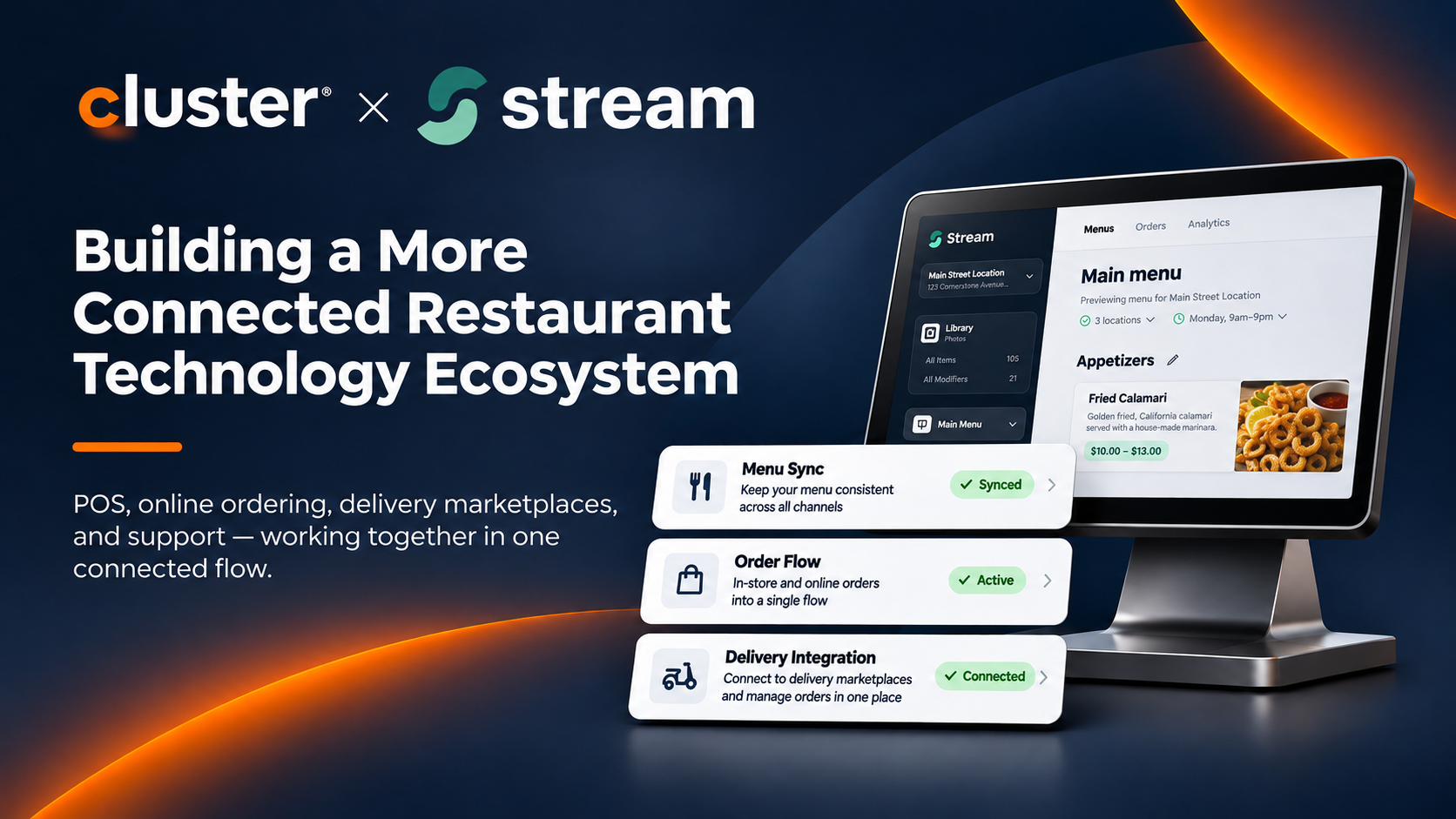
Stream Partner Spotlight: Cluster
For restaurant operators, the POS has become much more than a place to process transactions. It's the central hub connecting orders, menus, payments, delivery platforms, and the systems that keep restaurants running. In our latest Stream Partner Spotlight, we sat down with the team at Cluster, a Canadian restaurant technology provider, to discuss their approach to building a connected restaurant ecosystem, the importance of integrations in today's hospitality industry, and how Stream powers their Delivery Hub to simplify marketplace connectivity for restaurant operators.
How would you describe Cluster's core offering today, and what makes the platform different for hospitality operators?
Cluster is an all-in-one restaurant technology platform designed to simplify how hospitality operators run their businesses. We support restaurants across point of sale, online ordering, payments, hardware, integrations, and customer support, bringing the technology behind the operation into one connected ecosystem.
Two things set us apart in our market. First, we're built for Canadian restaurant reality, fully bilingual in French and English, with Revenu Québec fiscal compliance (MEV / WEB-SRM) handled natively rather than bolted on. That's not a feature on a list. It's the price of entry here, and it's where platforms built elsewhere tend to struggle.
Second, we're a hands-on technology partner, not a self-serve box. Our people do the install, help program the menu, train the staff, and answer the phone when something goes wrong on a Friday night. For an independent operator or a small chain without an IT department, that's the difference between technology that works on day one and a project they have to manage themselves.
How does Cluster think about the role of the POS as the connected center of restaurant operations?
The POS used to just ring in sales. Today, it's the heartbeat of the operation: every order, every price, every sold-out item, on every channel.
That's how we think about it. The operator keeps one menu in the POS, and everything else, including online ordering, delivery marketplaces, loyalty, accounting, and inventory, connects back to it instead of running its own separate copy.
An order from a delivery app prints in the kitchen exactly like a dine-in order. At the end of the night, it's all one set of numbers, not five.
The payoff is what happens when something changes. Update a price once, and it's updated everywhere. Add a new sales channel, and it just plugs in instead of becoming one more screen to watch, one more login to remember, or one more place a price can quietly go wrong.
Why are integrations such an important part of the Cluster value proposition?
Restaurants rely on an increasingly large technology stack, and no single provider can, or should, try to build every solution themselves.
Operators already have the delivery apps, the loyalty program they've built a customer base on, the scheduling tool their managers like, and the accounting software their bookkeeper insists on. Telling them to abandon all of that to buy one suite is a bad trade for them.
The value we add is letting them pick what's best in each category and having it all connect back to the POS: QuickBooks for accounting, Wisk for inventory, Freebees for loyalty, Libro for reservations, and Stream for delivery marketplace orders through our own Delivery Hub, among others.
Every one of those integrations exists because merchants asked for it.
There's a commercial reality too: an integration we don't have is a deal we don't win, and a merchant we can't keep. The ecosystem is a large part of what we're actually selling.
Where has Stream helped strengthen the offering, and what does that make easier?
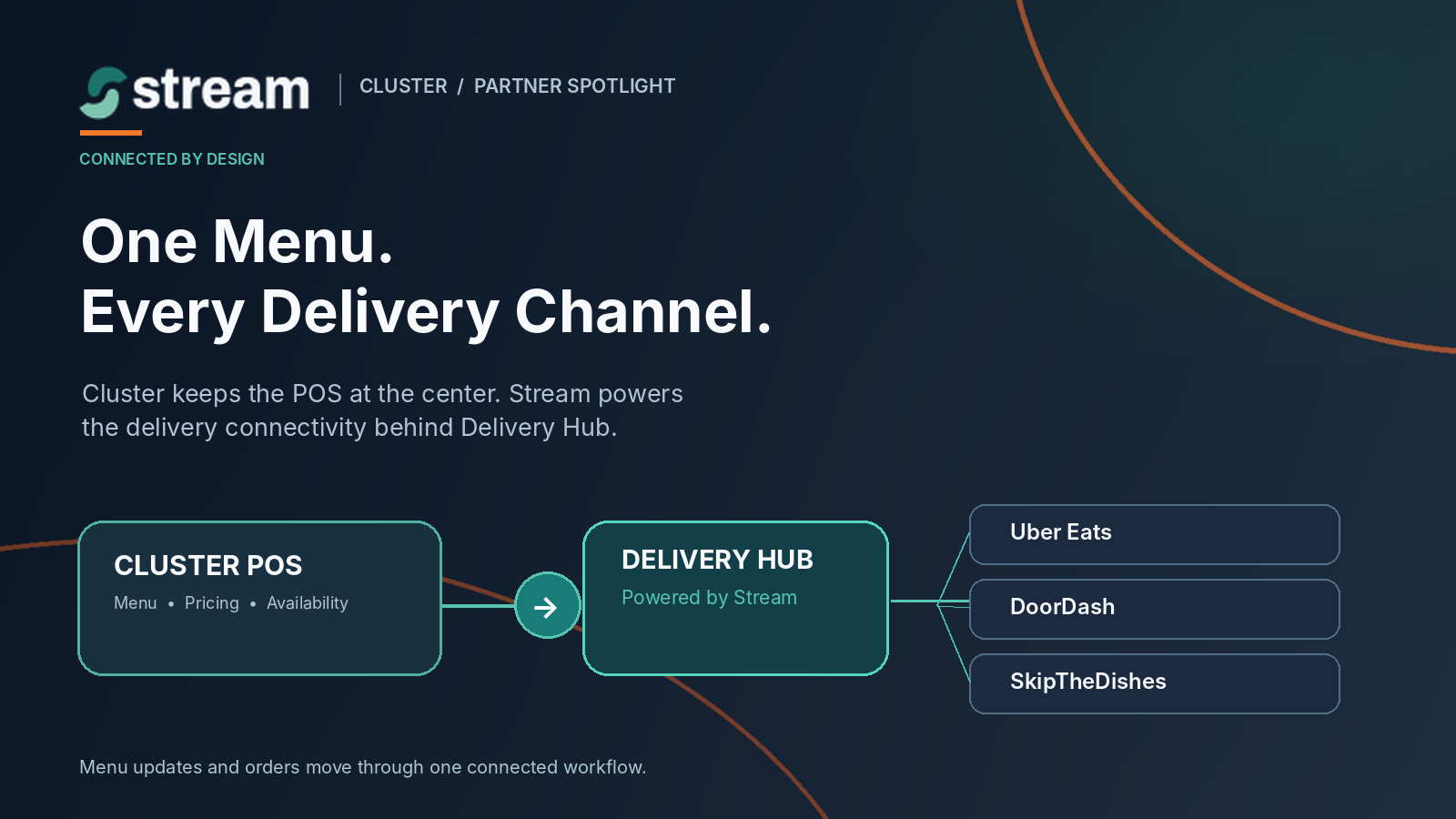
Stream powers Cluster Delivery Hub, which is how our merchants connect to Uber Eats, DoorDash, and SkipTheDishes.
Before an aggregation layer, every marketplace is its own project, with its own certification, menu structure quirks, failure modes, and relationship to maintain.
Stream turns that into one integration and one onboarding path. The merchant's POS menu publishes out to the platforms, and marketplace orders inject straight into the POS and print in the kitchen like any other order.
For our implementation team, that made delivery a repeatable playbook instead of a custom job per merchant. The pre-install checklist is the same whichever platforms the operator uses.
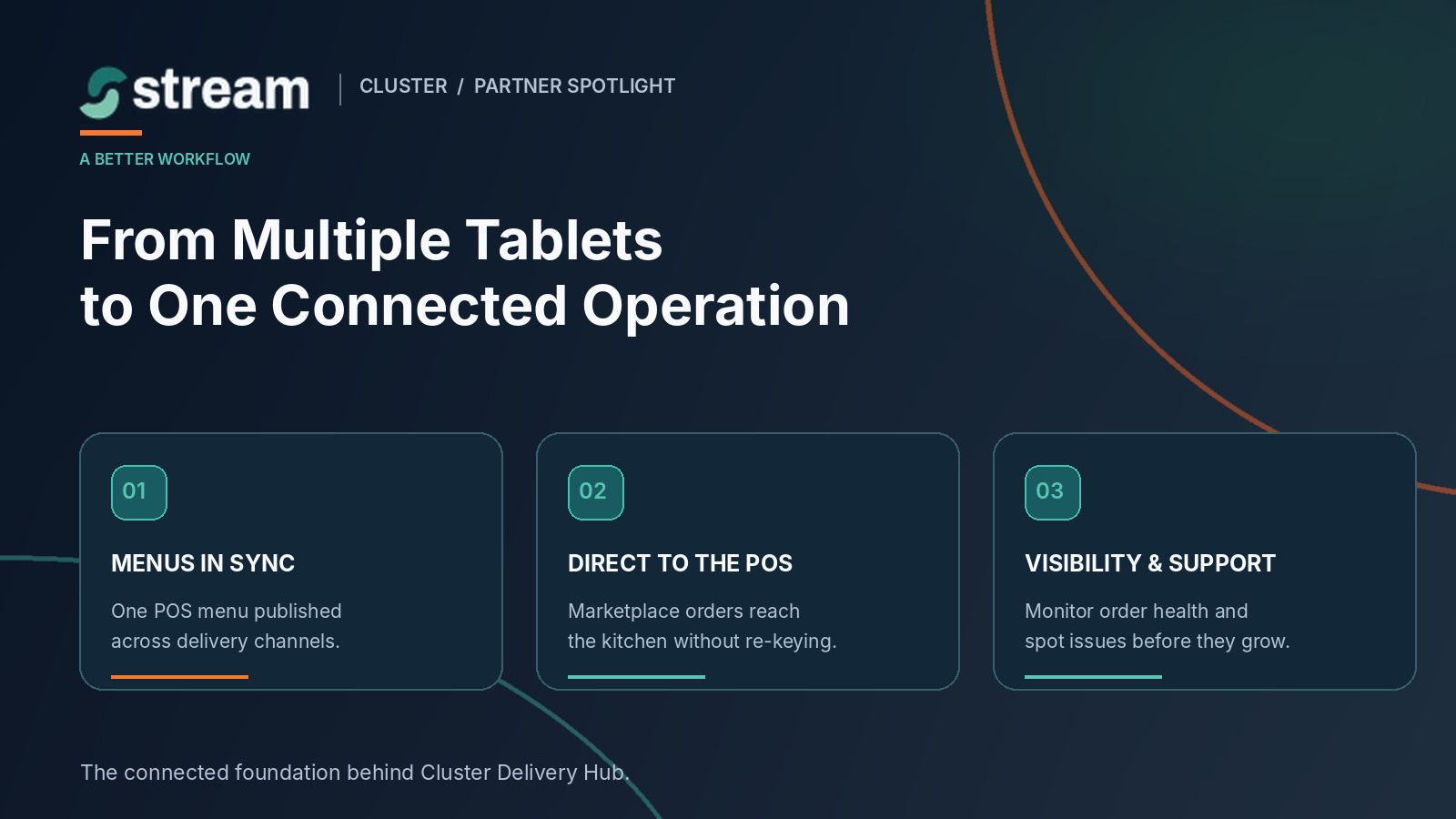
For support, the visibility tooling is the real gain: order health monitoring, alerts when a store goes offline on a platform, and enough detail to tell quickly whether an order failed on the delivery platform's side or ours.
That helps resolve a category of support ticket that used to mean phoning three different marketplaces. For anything else, we have a direct channel to the Stream team.
Stream's recognition as a 2026 DoorDash Preferred Integration Partner matters to us as well. Marketplace relationships and certifications are heavy lifting, and it's work we don't have to carry alone.
Where do Cluster merchants feel the most pain when systems don't connect cleanly?
Menu maintenance, first and worst.
An operator who changes a price or removes an item has to remember to make the same change in three marketplace portals. In practice, they don't always do it.
An item stays on sale that the kitchen can't make, and the order ends in a refund and a one-star rating. Or a platform is still selling last season's price, and the margin quietly disappears. Or a modifier group exists in the POS but not on the platform, and the kitchen gets an order it can't read.
Second, re-keying. A row of tablets on the counter and staff typing marketplace orders into the POS by hand at seven o'clock on a Friday. That's wrong items, wrong prep times, and a person tied up who should be serving customers.
Third, reporting. Delivery sales sitting outside POS totals means the operator can't close the day in one place, and tax and fee reconciliation becomes a monthly headache.
Fourth, silent downtime. A store gets toggled offline on a platform, and nobody notices until someone asks why Saturday was quiet.
Can you walk us through a typical merchant scenario and how Delivery Hub changes the experience?
Consider a multi-location restaurant operator with three locations, active on Uber Eats, DoorDash, and SkipTheDishes, and doing a meaningful share of its volume through delivery.
Without a connected delivery integration, each counter might have a tablet per platform, with menus maintained in multiple places and staff re-keying marketplace orders into the POS during the rush. Menu changes happen when someone has time, which means the platforms are often a little out of sync.
With Delivery Hub, the operator maintains one menu in the Cluster POS and publishes it to the marketplaces. Orders arrive directly in the POS and print in the kitchen like any other order. A price change or an item pulled for the day can be reflected across connected platforms without anyone logging into multiple marketplace portals.
Delivery sales also appear in the same end-of-day reports as everything else.
What the operator notices isn't necessarily a feature. It's that the counter is quieter during service, staff spend less time entering orders manually, and menu updates are easier to manage.
On our side, support conversations can shift from recurring menu synchronization problems to occasional one-off issues.
Looking ahead, where is Cluster focused, and how do partnerships help?
Our focus is to keep making the POS the place where the whole operation is actually run, and to keep being the one number an operator calls when something doesn't work.
Concretely, that means continuing to go deeper on payments and remaining the platform operators can run their whole business on.
On partnerships, we could try to build every connection ourselves and be slower at all of them, or we can partner with companies whose entire business is one category and move faster across the board.
Stream is the clearest example. Our merchants get marketplace connectivity, and we don't have to build and maintain a relationship with every delivery platform to give it to them.
Operators now expect their POS vendor to have already solved the connection to whatever they're using.
Our job is to make sure the answer is yes more often than anyone else's, and integrations are how we do that.


